

The fact that the most potent supercomputer ever constructed—a device spanning 680 square meters and consuming 22.7 megawatts of electricity—performs about the same number of operations per second as the organ inside your skull, using about the same energy as a tiny refrigerator bulb, is somewhat unsettling. Some of the world’s most ambitious and costly engineering projects have been motivated by that gap—or rather, the obstinate lack of one.
For many years, computing operated under the simple premise that performance would increase if transistors were made smaller and more numerous. For the most part, it worked. Physics then began to push back. As transistors get closer to the atomic scale, quantum effects cause electrons to tunnel through barriers they shouldn’t be able to cross, producing heat and introducing errors that impair performance. Moore’s Law, which states that transistor density will reliably double every two years, is not quite dead, but it is limping. When engineers are trying to figure out what comes next, they are increasingly coming to the conclusion that they should look at the brain.
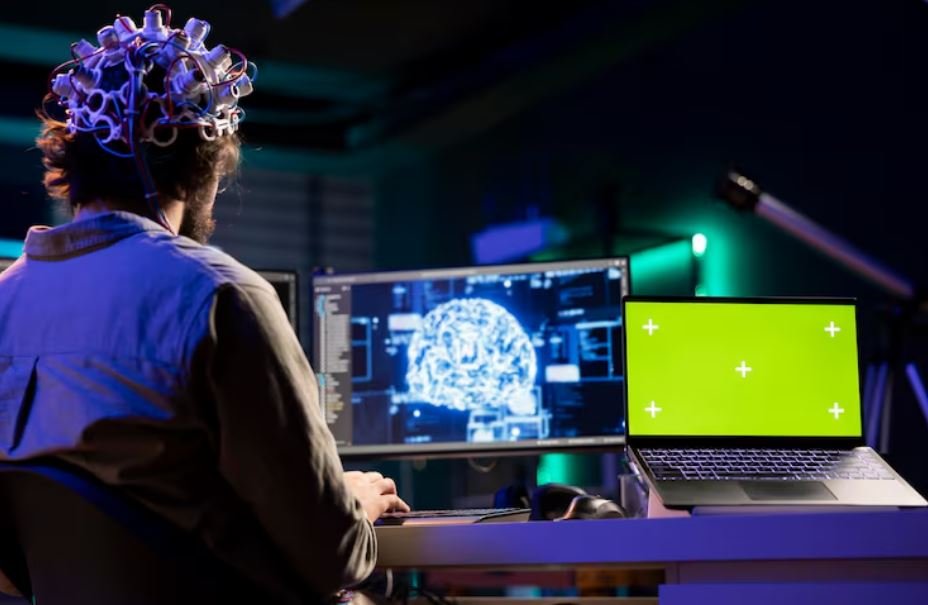
The method is called neuromorphic computing, and although its implementation is extremely challenging, its main concept is elegant. Neuromorphic systems completely blur the distinction between memory and processing, unlike almost all computers constructed since 1945. The brain’s neurons and synapses manage computation and storage at the same time, contributing to the brain’s remarkable efficiency. Researchers contend that a machine based on similar principles could provide something that existing supercomputers cannot: scale without the crippling energy cost.
Perhaps the best illustration of how seriously researchers are taking this direction is Australia’s DeepSouth, which went live at Western Sydney University in 2024. It is the first device built to replicate neural networks at the full scale of the human brain, with trillions of synaptic connections and billions of neurons operating in parallel. It can perform 228 trillion operations per second. Since these initiatives frequently take years to show results, it’s possible that DeepSouth won’t yield any breakthroughs right away. However, it truly goes beyond what traditional hardware can provide as a research platform for simulating neurological disorders and evaluating theories of cognition.
In 2022, Chinese researchers made a startling discovery on a completely different front. They trained an AI model named Bagualu with 174 trillion parameters using the Sunway supercomputer, which has 37 million CPU cores, nine petabytes of memory, and a processing speed comparable to the U.S. Department of Energy’s own Frontier machine. For comparison, at about the same time, Google’s renowned Switch Transformer reached the trillion-parameter milestone. The Chinese team described their model as brain-scale and highlighted its potential in computer vision, autonomous systems, and pharmaceutical research while operating at a scale that was more than 100 times larger. Although scientists are still debating whether 174 trillion parameters actually compares to the estimated thousand trillion synapses in a human brain, the goal behind the figure is difficult to discount.
However, it’s remarkable how much of this progress is obscured by uncertainty. Even after building incredibly complex systems, training them on data at scales that would have seemed unthinkable ten years ago, and observing them carry out tasks that no human-designed algorithm could handle, scientists are still unable to fully explain how the decisions are made. The so-called “black box problem” refers to the fact that trillion-parameter models are still somewhat opaque, even to those who created them. The field seems to be advancing more quickly than our comprehension of it.
The deeper question that underlies all of this hardware is one that researchers seldom explicitly state in press materials: what exactly have you built if you can successfully simulate a human brain at full scale using neuromorphic chips? By concentrating on energy efficiency, medical research, and AI performance, the neuromorphic pioneers are generally cautious to stay on the practical side of that question. However, it’s difficult to ignore the fact that the distinction between creating and simulating intelligence is becoming increasingly blurred as these machines approach biological parity.
