

The muon has been a problem in particle physics for over 20 years. It is a heavier, transient cousin of the electron that only lasts a few microseconds before decaying. Despite this short lifespan, it has embarrassed some of the most self-assured theorists in the world. The issue was easy to articulate but difficult to resolve.
When the strength of the muon’s magnetism was measured in the lab, it never quite matched what the Standard Model predicted. The muon behaves like a tiny magnet. It was a narrow gap. However, it would not go away.
| Field | Detail |
|---|---|
| Institution | Forschungszentrum Jülich |
| Location | Jülich, North Rhine-Westphalia, Germany |
| Lead Researcher (Coordination) | Prof. Kálmán Szabó |
| Supporting Researcher | Prof. Zoltan Fodor (ERC Advanced Grant holder) |
| Host Centre | Jülich Supercomputing Centre (JSC) |
| Supercomputers Used | JUWELS, JURECA, and JUPITER — Europe’s first exascale system |
| Subject Particle | The muon — a heavier, short-lived cousin of the electron |
| Field of Research | Lattice quantum chromodynamics (QCD), particle physics |
| Precision Achieved | Agreement with experiment within 0.5 standard deviations |
| Improvement Over Past Work | Uncertainty reduced by a factor of 1.6 |
| Validation Level | Standard Model confirmed to 11 digits of precision |
| Approach | Hybrid method combining lattice QCD with electron-positron collision data |
| Earlier Milestone | 2021 calculation that first narrowed the muon anomaly gap |
For years, some members of the physics community practically ignored that discrepancy. It was the kind of crack that people wanted to force open. The dream included new particles, hidden forces, and something that the equations did not account for. Every physics conference has the feeling that scientists are secretly hoping the Standard Model doesn’t work. Failure is where new science starts, not because they don’t like it. For a while, their most promising failure was the muon discrepancy.
Then, in 2021, the Jülich team made a calculation that subtly changed the course of events. The gap appeared less like a doorway and more like a measurement problem as the theoretical prediction approached the experimental number. It was welcomed by some physicists. You could tell that others were dissatisfied. More romantic than sophisticated math is new physics.
The same team has now advanced. Researchers have used the Jülich supercomputers, JUWELS, JURECA, and JUPITER, Europe’s first exascale machine, to produce a calculation so accurate that it nearly stops the conversation. Compared to before, the new uncertainty is 1.6 times lower. Now, the agreement between theory and experiment is within half a standard deviation. Up to eleven digits are stored in the Standard Model, that flawed but unyielding framework developed over fifty years. Even romantics find it difficult to disagree with that degree of agreement.
It is worthwhile to consider the true meaning of this level of precision. The Jülich contribution was coordinated by Prof. Kálmán Szabó, who likened the accuracy of the experiment to weighing a human being and being unsure based only on the weight of one eyelash. You remember that picture. The majority of us are unable to measure flour down to the gram. The magnetic personality of a particle that hardly exists long enough to be observed is being measured by these researchers.
Prof. Zoltan Fodor noted that the strong force, which holds quarks inside protons, is the difficult part. The majority of the calculation’s difficulty stems from its inability to behave consistently across various energy scales. The team’s solution was a sort of hybrid, combining carefully selected experimental data from electron-positron collisions with lattice QCD simulations to do the heavy lifting. This degree of accuracy would not have been possible with either approach alone. They did it together.
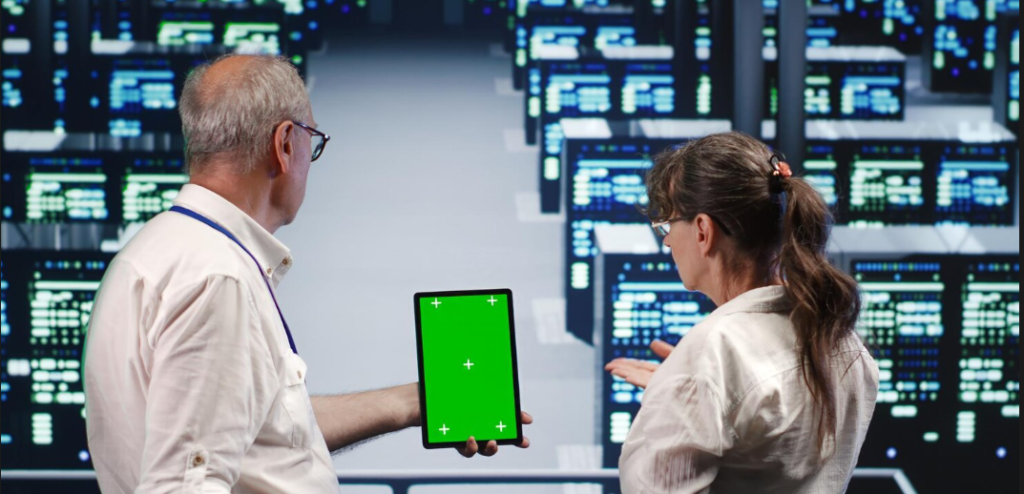
Particle physics is not visible when you stroll through the Jülich Supercomputing Center. You can see engineers using laptops to move between aisles, rows of server racks, cables overhead, and the constant hum of cooling systems. JUPITER is a silent, blinking behemoth. It’s odd to consider that something as ethereal as the magnetism of the muon is pinned down here, in a structure that resembles a logistics center rather than a lab.
Naturally, there is still opportunity for surprise. Their numbers will continue to be refined through experiments. Some theorists will never stop looking for fissures. However, it appears that the muon, that tiny, restless particle that held so much promise, has nothing more to reveal for the time being. It’s difficult not to feel a quiet kind of admiration as you watch this happen. For the patience required to validate the old, not for the discovery of new physics.
