
Close Menu
Cubox-iCubox-i
  • Homepage
  • Contact Us
  • Privacy Policy
  • Terms of Service
  • Disclaimer
  • About Us
  • Cubox
  • News
  • Technology
What's Hot

Utah Medical Board Suspends State’s AI Doctor Experiment After Misdiagnosis Scare

June 5, 2026

The ARM Mini Computer That Ships With Full Industrial Certifications and Fits in the Palm of Your Hand

June 5, 2026

Tesla’s Dojo vs. The Cloud: A Divergent Strategy in the AI Hardware Race

June 5, 2026
Cubox-iCubox-i
Subscribe
  • Homepage
  • Contact Us
  • Privacy Policy
  • Terms of Service
  • Disclaimer
  • About Us
  • Cubox
  • News
  • Technology
Cubox-iCubox-i
Home»AI»How Nvidia Is Using Software to Speed Up Its Data Center Networking Hardware for AI Workloads
AI

How Nvidia Is Using Software to Speed Up Its Data Center Networking Hardware for AI Workloads

Blaze WoodardBy Blaze WoodardJune 5, 2026No Comments4 Mins Read
Facebook Twitter Pinterest LinkedIn Tumblr WhatsApp VKontakte Email
Share
Facebook Twitter LinkedIn Pinterest Email

Every hardware company has a point in its development when silicon begins to get in the way. It seems that Nvidia has reached one of those points, not because its GPUs are slowing down but rather because the cables that connect them are. Individual data centers are reaching the limits of power and capacity within a single facility as the demand for AI soars. Businesses are dispersing their GPU clusters throughout buildings, campuses, and sometimes entire regions. Furthermore, the decades-old Ethernet protocol that connects the internet wasn’t designed to withstand that kind of punishment.

When the off-the-shelf world fails, Nvidia does what it usually does. It created new software. Nvidia’s most recent Ethernet equipment comes with software protocols called Spectrum-XGS algorithms. In order to enable distributed GPUs in servers spread across several data centers to function as a single, cohesive AI supercomputer, they automatically modify long-distance networking performance. There isn’t a big hardware announcement or new chip, so it’s a subtle but significant move. Simply put, code can accomplish things that hardware cannot. Nvidia’s senior vice president of networking, Gilad Shainer, explained to reporters that while there isn’t a new hardware component, the new algorithms efficiently transfer more data over greater distances between locations.

It is important to comprehend the specific technical issue being resolved here. A major risk in AI clusters is jitter: if one GPU lags because of a delay, all cooperating GPUs have to wait, which has a direct effect on overall performance. Regardless of how quickly the others run, if one runner falters in a relay race, the entire team loses time. This type of synchronization failure causes more than just a slowdown in a training cluster that is dispersed over hundreds of kilometers. It disrupts the entire process.

While Spectrum-XGS automatically adjusts the algorithm based on the required distance, traditional Ethernet usually handles all connections equally. That distinction is more important than it may seem. The physics of a packet moving through three states is completely different from that of a packet moving within a single server rack. In addition to custom algorithms that offer end-to-end telemetry and automatic congestion control mechanisms, Nvidia software controls the hardware. In real time, the system observes, learns, and makes adjustments, packet by packet.
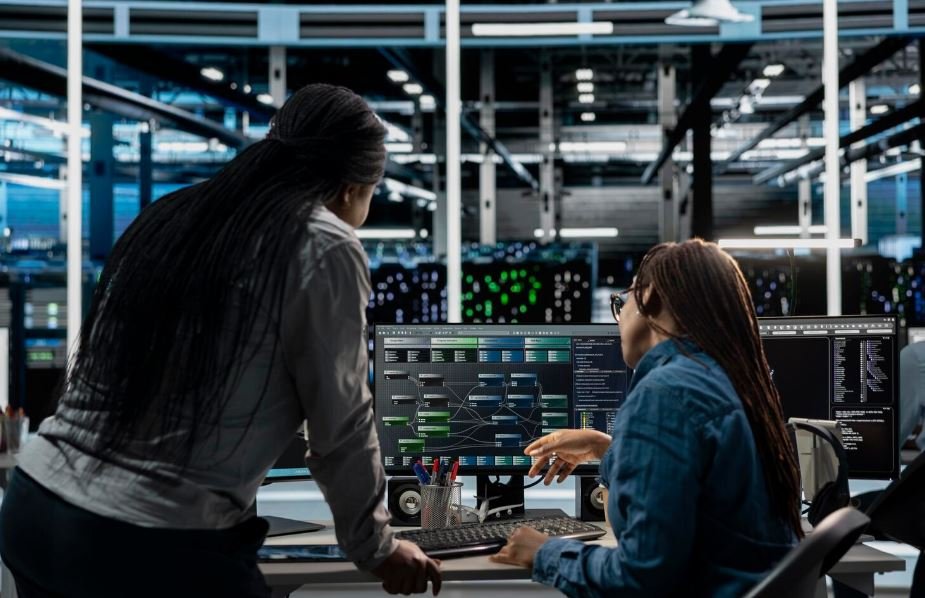
how nvidia is using software to speed up its data center networking hardware for ai workloads

In comparison to off-the-shelf networking technology, Nvidia measured a 1.9x improvement in GPU-to-GPU communication when testing XGS algorithms in its server hardware. It’s not a marginal gain. Nearly doubling throughput across geographic distances alters what is financially feasible for businesses conducting large training runs where compute costs can reach tens of millions of dollars. Although it’s still unclear if every deployment will actually see those figures, the benchmark is difficult to ignore.

It’s important to remember that Nvidia isn’t working alone in this situation. Optical switching is used by Google’s massive Jupiter network to enable quick communication between its AI chips. For years, cloud providers have been discreetly constructing their own high-speed long-distance networks. The distinction is that Nvidia is attempting to make this level of performance available to everyone using Spectrum-X equipment, not just the hyperscalers who can afford to construct custom infrastructure from scratch. This is where Nvidia’s approach becomes intriguing. As an early adopter, CoreWeave offers a practical demonstration of the technology’s capacity to get around physical data center constraints.

Spectrum-XGS is not a stand-alone technology; rather, it is a crucial component of Nvidia’s full-stack AI ecosystem. The company has also disclosed software-level performance improvements that work in tandem with Spectrum-XGS to facilitate hardware-algorithm-software cooperation. Everything Nvidia has been developing revolves around this integration, not just faster components but also a closer loop between silicon and software that rivals find extremely challenging to imitate. As this develops, it seems that networking is becoming as strategically significant to Nvidia as the GPU.

It remains to be seen if this translates into Nvidia’s level of dominance in accelerated computing. Ethernet is an open standard by design. Many businesses, including Broadcom, are fiercely competing on this same field, and vendors make their own adjustments. At least for the time being, Nvidia has a system where the networking software is aware of exactly what the GPUs are doing in real time and makes the necessary adjustments. The fact that the algorithms were developed by the same company that manufactured the chips they serve may prove to be the true advantage, rather than the algorithms themselves.

AI Workloads Networking Hardware Nvidia Is Using Software
Share. Facebook Twitter Pinterest LinkedIn Tumblr WhatsApp Email
Previous ArticleWhy the Real Quantum Race Is Shifting From Hardware to Software — and the Companies Already Winning That Battle
Next Article Supercomputing the Mind: The Trillion-Parameter Push for Artificial Brains
Blaze Woodard

    Blaze Woodard, an editor at cubox-i.com, is presently working as an intern at a Silicon Valley technology company while majoring in politics at the University of Kansas. Blaze, who identifies as both a policy thinker and a self-described tech geek, offers a viewpoint on hardware and computing coverage that few editors in this field can match: the capacity to relate the workings of a circuit board to the larger political, regulatory, and social forces influencing the technology sector. Even though her academic path led her to political science, her early fascination with technology persisted. She writes about computing, AI, and hardware with the zeal of someone who truly loves the subject, not as someone assigned to cover it. Blaze plays soccer and spends her free time with friends and living her life, which is exactly what a college student should do outside of the office and newsroom.

    Related Posts

    Utah Medical Board Suspends State’s AI Doctor Experiment After Misdiagnosis Scare

    June 5, 2026

    The ARM Mini Computer That Ships With Full Industrial Certifications and Fits in the Palm of Your Hand

    June 5, 2026

    Tesla’s Dojo vs. The Cloud: A Divergent Strategy in the AI Hardware Race

    June 5, 2026

    The Day the Encryption Broke: Why Cybersecurity’s ‘Q-Day’ Is Closer Than You Think

    June 5, 2026
    Leave A Reply Cancel Reply

    You must be logged in to post a comment.

    Don't Miss
    AI

    Utah Medical Board Suspends State’s AI Doctor Experiment After Misdiagnosis Scare

    By Blaze WoodardJune 5, 20260

    Someone made a choice somewhere in the offices of the Utah Department of Commerce that…

    The ARM Mini Computer That Ships With Full Industrial Certifications and Fits in the Palm of Your Hand

    June 5, 2026

    Tesla’s Dojo vs. The Cloud: A Divergent Strategy in the AI Hardware Race

    June 5, 2026

    The Day the Encryption Broke: Why Cybersecurity’s ‘Q-Day’ Is Closer Than You Think

    June 5, 2026

    The Micro-PC Wars: CuBox vs. Raspberry Pi in the Battle for the Edge

    June 5, 2026

    The Dark Side of the AI Hardware Boom: E-Waste and the ITAD Sector’s Nightmare

    June 5, 2026

    The Data Center Dilemma: As AI Hardware Heats Up, Power Grids Feel the Strain

    June 5, 2026
    About Us
    About Us

    Cubox-i.com is an independent technology publication that focuses on edge AI, industrial hardware, compact ARM computing, and the wider field of technology news that is important to engineers, developers, manufacturers, and knowledgeable readers in the US and abroad.

    Our Picks

    Utah Medical Board Suspends State’s AI Doctor Experiment After Misdiagnosis Scare

    June 5, 2026

    The ARM Mini Computer That Ships With Full Industrial Certifications and Fits in the Palm of Your Hand

    June 5, 2026

    Tesla’s Dojo vs. The Cloud: A Divergent Strategy in the AI Hardware Race

    June 5, 2026
    Dsclaimer

    Cubox-i.com publishes content about markets, finance, investments, and economic issues solely for educational and informational purposes. It’s not financial guidance. Opinion pieces and analysis from independent industry leaders and commentators are regularly published by us; however, these viewpoints are presented as those of the contributors and do not represent cubox-i.com’s recommendations.

    We’re It is highly advised that readers consult a qualified, licensed financial advisor before making any financial decisions based on information found on this website, including purchasing, selling, or holding any investment, asset, or financial product.

    • Homepage
    • Contact Us
    • Privacy Policy
    • Terms of Service
    • Disclaimer
    • About Us
    • Cubox
    • News
    • Technology
    © 2026 ThemeSphere. Designed by ThemeSphere.

    Type above and press Enter to search. Press Esc to cancel.