
Close Menu
Cubox-iCubox-i

    Subscribe to Updates

    Get the latest creative news from FooBar about art, design and business.

    What's Hot

    Quantum Algorithms Just Outperformed Deep Learning. The Paradigm is Shifting.

    April 25, 2026

    Why Earning an AI Certification is the Ultimate Professional Pivot for 2026

    April 25, 2026

    The Pick-and-Shovel Stocks Positioned for the Quantum-AI Convergence That Nobody on Wall Street Is Covering Yet

    April 25, 2026
    Facebook X (Twitter) Instagram
    Cubox-iCubox-i
    Subscribe
    • Homepage
    • Privacy Policy
    • Terms of Service
    • Disclaimer
    • About Us
    • Cubox
    • News
    • Technology
    Cubox-iCubox-i
    • Home
    • Buy Now
    Home»Cubox»From Super to Microcomputer: The Quiet Reshaping of How We Compute
    Cubox

    From Super to Microcomputer: The Quiet Reshaping of How We Compute

    Blaze WoodardBy Blaze WoodardApril 25, 2026No Comments4 Mins Read
    Facebook Twitter Pinterest LinkedIn Tumblr WhatsApp VKontakte Email
    Share
    Facebook Twitter LinkedIn Pinterest Email

    In the early 1970s, a college computer lab would have looked more like a furnace room than an office. Men wearing short-sleeved shirts and wide ties attended to the entire setup, which included refrigerator-sized cabinets humming against the walls and vents expelling warm air. Before breakfast, a single machine could fill a hall, require its own cooling system, and still not be able to handle what a modern phone can. It’s difficult to ignore how swiftly that world vanished.

    During that time, the supercomputer was the main event. Soft-spoken engineer Seymour Cray, who liked to work alone in a basement in Wisconsin, created devices that stretched the capabilities of silicon. His Cray-1, which had a padded bench around the base and an odd horseshoe shape, came to represent raw computing power in popular culture. They were purchased by governments. They were essential to weather agencies. Eventually, they were used by film studios to render dinosaurs.

    InformationDetails
    TopicEvolution from supercomputers to microcomputers
    Microcomputer PioneerBill Pentz and team (Sol-20, mid-1970s)
    Supercomputer PioneerSeymour Cray, founder of Cray Research
    Microcomputer SpeedRoughly 70 to 100 MIPS
    Supercomputer SpeedRoughly 100 to 900 MIPS in classical benchmarks; modern systems measured in petaflops
    Common Microcomputer ExamplesLaptops, desktops, IBM PC
    Common Supercomputer ExamplesCray series, Sunway TaihuLight, Frontier
    Modern Server LeaderSuper Micro Computer Inc. (NASDAQ: SMCI)
    HeadquartersSan Jose, California
    FY2025 Revenue$22 billion (up from $15 billion in FY2024)
    Employees (June 2025)6,238
    Primary Use CasesMicrocomputers for daily office and home work; supercomputers for weather forecasting, astronomy, AI training, defense

    The other side of the story then emerged. A more subdued group of engineers, including Bill Pentz and his group, were working on a nearly diametrically opposed project around the same time. They wanted smaller buildings rather than larger ones. That instinct gave rise to the microcomputer, which most of us now simply refer to as a personal computer. There was only one processor. At least in comparison, it was inexpensive. It might be placed on a desk. Additionally, it altered day-to-day existence in ways that the supercomputer never attempted or succeeded in.

    The two worlds hardly interacted for decades. Supercomputers were used for tasks requiring thousands of processors operating in parallel, such as data mining, robot design, and astronomy. Spreadsheets, schoolwork, and family photos were all handled by microcomputers. One ran whatever operating system the buyer wanted to install that week, while the other used Linux and custom architecture. Really, there was no overlap until the AI boom made it necessary.
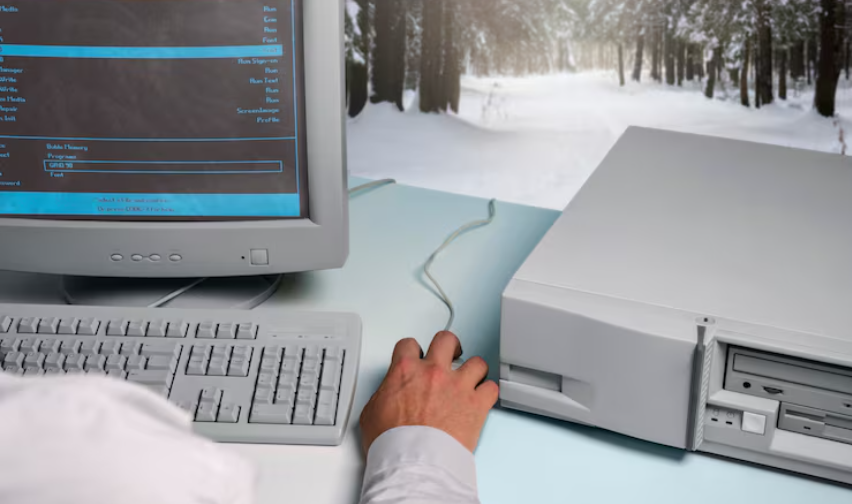
    From Super to Microcomputer
    From Super to Microcomputer

    That’s what makes the present moment peculiar. The distinction between the two has begun to become hazy, and the business that stands to gain the most is not the one that most people would anticipate. Before becoming what some on Wall Street now refer to as the unsung partner of the Nvidia era, Super Micro Computer, with its headquarters located in San Jose, was a quiet supplier of server hardware for many years. From $15 billion in fiscal 2024 to $22 billion in fiscal 2025, its revenue increased dramatically. It appears that investors think the run is still ongoing.

    In essence, Super Micro creates the link between the two realms of computing. Its servers are neither the lonely desktop nor the room-sized monster, packed with Nvidia’s Hopper and Blackwell chips and increasingly cooled by liquid rather than air. They can be assembled into clusters that function like supercomputers without having a supercomputer-like appearance because they are modular and stackable. Although it sounds like marketing jargon, the company’s name, Server Building Block Solutions, accurately sums up the engineering.

    Even though the circle’s shape is strange, there’s a sense that we’ve come full circle. Computing became personal with the advent of the microcomputer. It was powerful because of the supercomputer. Something in between is currently taking place in unmarked warehouses outside of Taipei and throughout Texas and the Netherlands. It’s still unclear if that middle ground will hold or if the next change will push everything back toward one extreme. You get the impression that the engineers themselves aren’t totally certain as you watch this play out.

    From Super to Microcomputer From Super to Microcomputer 2026
    Share. Facebook Twitter Pinterest LinkedIn Tumblr WhatsApp Email
    Previous ArticleInside the CuBox-M: A Tiny Israeli Computer Punching Far Above Its Weight
    Next Article Linux Distros Ready: Why Ubuntu, Fedora, and Debian Still Define the Desktop
    Blaze Woodard

      Blaze Woodard, an editor at cubox-i.com, is presently working as an intern at a Silicon Valley technology company while majoring in politics at the University of Kansas. Blaze, who identifies as both a policy thinker and a self-described tech geek, offers a viewpoint on hardware and computing coverage that few editors in this field can match: the capacity to relate the workings of a circuit board to the larger political, regulatory, and social forces influencing the technology sector. Even though her academic path led her to political science, her early fascination with technology persisted. She writes about computing, AI, and hardware with the zeal of someone who truly loves the subject, not as someone assigned to cover it. Blaze plays soccer and spends her free time with friends and living her life, which is exactly what a college student should do outside of the office and newsroom.

      Related Posts

      Why Earning an AI Certification is the Ultimate Professional Pivot for 2026

      April 25, 2026

      Quantum Computing Stocks IonQ, Rigetti, and D-Wave Just Soared 72% in Seven Trading Sessions. Here Is the Honest Assessment.

      April 25, 2026

      Apple’s Hidden Server Farm: The Secret Hardware Powering Private Cloud Compute

      April 25, 2026

      Meet the CuBox-M: The Two-Inch PC Built for the Next Generation of Makers

      April 25, 2026
      Leave A Reply Cancel Reply

      You must be logged in to post a comment.

      Don't Miss
      All

      Quantum Algorithms Just Outperformed Deep Learning. The Paradigm is Shifting.

      By Blaze WoodardApril 25, 20260

      A refrigerator the size of a small car hums at temperatures lower than deep space…

      Why Earning an AI Certification is the Ultimate Professional Pivot for 2026

      April 25, 2026

      The Pick-and-Shovel Stocks Positioned for the Quantum-AI Convergence That Nobody on Wall Street Is Covering Yet

      April 25, 2026

      Quantum Computing Stocks IonQ, Rigetti, and D-Wave Just Soared 72% in Seven Trading Sessions. Here Is the Honest Assessment.

      April 25, 2026

      Apple’s Hidden Server Farm: The Secret Hardware Powering Private Cloud Compute

      April 25, 2026

      Meet the CuBox-M: The Two-Inch PC Built for the Next Generation of Makers

      April 25, 2026

      Inside the Server Room: Discovering the Most Used OS on Servers Today

      April 25, 2026
      About Us
      About Us

      Cubox-i.com is an independent technology publication that focuses on edge AI, industrial hardware, compact ARM computing, and the wider field of technology news that is important to engineers, developers, manufacturers, and knowledgeable readers in the US and abroad.

      Our Picks

      Quantum Algorithms Just Outperformed Deep Learning. The Paradigm is Shifting.

      April 25, 2026

      Why Earning an AI Certification is the Ultimate Professional Pivot for 2026

      April 25, 2026

      The Pick-and-Shovel Stocks Positioned for the Quantum-AI Convergence That Nobody on Wall Street Is Covering Yet

      April 25, 2026
      Dsclaimer

      Cubox-i.com publishes content about markets, finance, investments, and economic issues solely for educational and informational purposes. It’s not financial guidance. Opinion pieces and analysis from independent industry leaders and commentators are regularly published by us; however, these viewpoints are presented as those of the contributors and do not represent cubox-i.com’s recommendations.

      We’re It is highly advised that readers consult a qualified, licensed financial advisor before making any financial decisions based on information found on this website, including purchasing, selling, or holding any investment, asset, or financial product.

      Facebook X (Twitter) Instagram Pinterest
      • Homepage
      • Privacy Policy
      • Terms of Service
      • Disclaimer
      • About Us
      • Cubox
      • News
      • Technology
      © 2026 ThemeSphere. Designed by ThemeSphere.

      Type above and press Enter to search. Press Esc to cancel.