

Inside, the air is filtered a million times over. Workers, fully clothed in suits that cover every inch of skin, move slowly and deliberately. Standard fluorescents would contaminate the photolithography process, so the lights are a specific shade of yellow. It’s difficult to ignore how strange a semiconductor cleanroom feels when watching video from an Intel facility or reading descriptions from IMEC researchers. These are carefully regulated settings created to be fundamentally incompatible with human biology. Additionally, they are now required to become even more extreme as chips get smaller and stack higher.
What was once a manufacturing detail has evolved into a major strategic issue. Advanced packaging has subtly moved from the back end of chip production to its center of gravity. This involves assembling multiple chips, stacking them in three dimensions, connecting them through dense silicon interposers, and integrating high-bandwidth memory alongside compute dies. Businesses like TSMC, Samsung, and a few specialty packaging companies now have a lot of power in the AI supply chain—not because of their designs, but rather because of their ability to assemble things precisely.
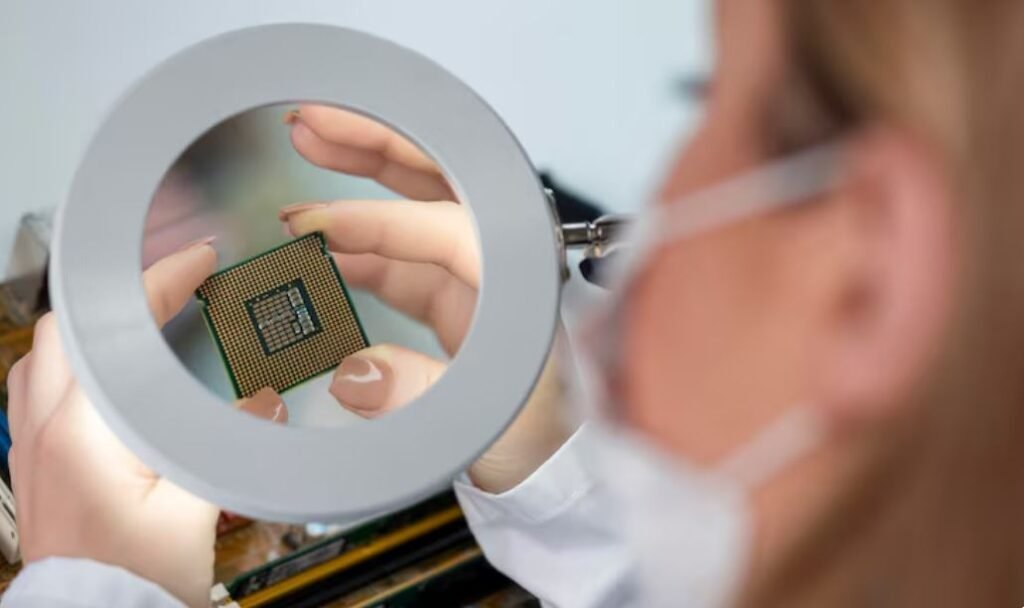
All of this is driven by very harsh physics. These days, an AI chip is more than just a single piece of silicon. Compute dies, memory stacks, and the minuscule connections that thread between them make up this package. For example, this type of architecture is used in NVIDIA’s most recent processors to ensure that the math units receive data quickly enough to justify the electricity bill. Although close chip stacking increases performance, it also increases the likelihood of an issue. a gap between bonded layers that is a few microns wide. A misalignment that was invisible to the human eye. These are the failure modes that make advanced packaging genuinely challenging and consequential.
The market is already reacting to that financial challenge. The market for semiconductor cleanrooms is expected to grow from its estimated $8 billion in 2025 to nearly $12 billion by 2030. Demand for more sophisticated factories is contributing to this growth, but packaging—the back-end procedures that were once thought to be less glamorous than lithography—is also playing a bigger role. Because even gloved hands increase the risk of contamination at the tolerances these packages require, robotic arms are gradually replacing human handlers. Ironically, the industry that creates machines that mimic human intelligence is actively trying to eliminate real humans from the process.
All of this is made more tense by the circumstances in China. Although its domestic chip packaging capabilities have improved, the nation is still limited at almost every other stage of the supply chain. It is unable to manufacture the most sophisticated photolithography machines, lags behind TSMC by years in logic fabrication, and is still working toward high-bandwidth memory at scale.
Chinese companies have made significant strides in the packaging industry, but even this is constrained by the inputs they receive. Improved packaging infrastructure won’t help you much if you can’t source top HBM or fabricate competitive compute dies. Although it’s possible that China will close these gaps more quickly than analysts anticipate, the current honest assessment is that the bottlenecks are structural.
Concerning some of the key technologies involved, a legal dispute is also subtly developing. The possibility of supply chain disruption for both AI hardware and medical devices has been brought up by a recent lawsuit involving atmospheric plasma technology, which is used in chip packaging and surface preparation. In the semiconductor industry, patent disputes often have unintended consequences. It has previously occurred in the industry.
There is a feeling that the semiconductor discussion has been overly narrowly focused on the headline numbers, such as nanometer nodes, transistor counts, and raw compute performance, as this entire ecosystem is changing. The actual constraint is forming in the packaging layer, the cleanroom infrastructure that supports it, and the inspection technologies that look for flaws that are not visible to any camera sold at a consumer electronics store. The rooms and hands—robotic or not—that assemble the chips that everyone is racing to build will determine their quality.
